1.079 V&A tour, cap

Wednesday, 2/19/2020

The only scheduled thing today is the “Behind the Scenes” tour at the Victoria & Albert. I’ve been looking forward to this inside look at the conservation departments of a real museum, and my friends at CHM were envious.

Big disappointment right off the top: no photos allowed! Our tour group with a nice docent lady was escorted by Robin, a burly security guy in a blue suit, who had the keys to open all the “staff only” doors for us. There were so many times in this hour when I craved to take a picture, and couldn’t!

There are several conservation rooms, and they look alike. That’s because the North (I think? or maybe East) end of the original building was originally the School of Art. The original purpose of the V&A was to teach and promote British artists and artisans. The collection was to provide examples for study. To give art students the proper working conditions, they were provided with studio spaces, and these are very high-ceiling rooms (25 foot at least) with windows from five foot to the top. These bright tall spaces are now the conservation rooms. (They didn’t call them “labs” although that would be appropriate.)

We went through the paper conservation room, the book and painting room, and the fabric and clothing room. All were these tall rooms with tons of indirect light. All had lots of open tables or benches, and lots of storage cabinets. An unexpected feature of all the rooms were “elephant-trunk evacuators”. Hanging from the ceiling on pantograph arms were six-inch corrugated ducts. A worker can reach up and pull one of the elephant trunks down to provide a flow of exhaust air, to carry away dust or solvent fumes.

The paper room had a stack of “carry boards”, big flat boards painted red. Conservators could stick a poster or print down to a carry board with dabs of wheat gluten paste at the corners. Then any opening in the print would show the red color through. We didn’t see anyone actually working on paper.

The book room had a lot of steam-punk looking screw presses and an awesomely large paper cutter. It also has some kind of computerized machine for making their own, custom-sized, acid-free storage boxes. I thought the docent said it was the “Kund machine” but that doesn’t google, so maybe I mis-heard her.

The painting department was at the end of that room. They had a bunch of big wooden easel/frames that could adjust to hold a painting. Off to the side I noted a binocular microscope mounted on a mobile, vertical frame so you could scan it up and across the face of a painting. Only one painting being worked on, a gentleman in a suit who showed an elaborately flowered waistcoat under the suit coat. What made this special was that the family that donated it, had preserved that waistcoat for 200 years, and donated it together with the painting. So now I guess the conservators were using the original garment to color-check the painting.

The apparel department was the largest room, and it was jammed with all sorts of mannequins. The V&A has a very large collection of garments. There is a rotating display of clothing, on mannequins, just off the main entry hall. We were told that each garment can be on display no more than two years out of any ten years. The other time it is in storage away from the light. So when a dress or suit comes out of storage, they need a mannequin of the proper size to stretch it out on and tidy it up.

The apparel department was busy because they were just at the start of taking down the current special exhibit of Mary Quant styles (remember Mary Quant? I did not pay the extra fee to tour that exhibit) and getting ready to put up a special display of kimonos. We were told the museum has a big collection of kimonos, but for this exhibit they are getting a lot of loans from private collectors. We got to look at one of these: a blue silk kimono with embroidered humming birds and flowers. The flowers were orange, and we were told that it was safflower dye, which is “insanely light-sensitive” so it has to be kept covered most of the time. Do you ever wash them, one of the guests asked. Shake of the head from the conservator, we only very rarely put water on anything. She went on, “You see these gold threads?” (in the kimono) “They are made by wrapping paper around thread, and gold leaf around the paper, and if they get wet the paper dissolves and the gold goes away.”

We couldn’t get into the sculpture conservation room because some kind of training class was being held. But they had big tables for work, and lift-tables much like one at our warehouse, for raising heavy objects to the work surface. Oh, I also spotted a couple of vacuum cleaners like the one at Yosemite. And there were a couple of electric fork-lift trucks out in a hallway. And I spotted twill tape in the book department, used to tie bundles of pages together.

I wanted to ask about how they track the location of objects. They have roughly 50 times as many artifacts as CHM does, a few thousand on display, and from what I could see, probably a few hundred circulating through the conservation department. What is their computer system like? How do they keep locations updated? I wasn’t able to ask anyone who knows. There were many computer screens around, but I did not see a single bar-code or bar-code reader, so probably not that way.

The tour was over; it was after 12. What should I do now? I thought I might go hat shopping. I’d noted the addresses of a few men’s hatters. One was not too far away, so I walked there, near Harrod’s, in light rain. Unfortunately from the street it appeared to stock only, or at least mainly, women’s hats, so I came away. I got some lunch at a rather posh tea room: soup and a side of chicken liver pate.

Now what? OK, a definitely gentlemen’s hatter was Bates, over in the posh shopping district off Picadilly. I walked back past all the museums to the South Kensington tube station. Passing the block-long massive queues of parents and kids outside the Natural History Museum in the rain. Note to self: never go to London in the half-holiday week.

At Bates I only bought a cap. I’ve been wanting a British cap for some time. They also had a lot of really intriguing fedoras, but I just didn’t feel like trying to select one today. I was getting pretty tired (huh, what a wus, only gone 10,188 steps/4.6 miles) and came on home. Later tonight I’ll go out somewhere local for supper. Then try to plan something to do in the morning, before starting for Heathrow at noon.


1.078.2 Matilda

Out at 5-ish for supper and a show. The show, Matilda the Musical, was at the Cambridge theater, in yet another part of London I’d never seen. It’s the Covent Garden district, although not the actual marketplace; the Seven Dials, where seven streets radiate out from a common point. Look it up on the g.map. Street view shows it nicely.

I wasn’t sure where to eat supper, so strolled around up and down the radiating streets, and found the Seven Dials Market, a large, two-level, food court, similar to a food court in a mall, maybe a bit edgier in tone and, big difference, no chain outlets, all local entrepreneurs. I walked all around and finally settled on a big bowl of ramen with chicken. Japanese food, but no asians in sight.

Then back to the theater for Matilda. This is a very silly fairy-tale story by Roald Dahl, staged with huge energy and enthusiasm. Here is the official trailer, although the images in that are out of sequence and jumbled. There is a plot and a flow, which you would never guess from that video. The kids in the show, maybe 10 of them under the age of 12, are amazing. They execute long, complex, athletic dance sequences in perfect unison, and act and sing. The lead role is apparently rotated among four girls. The one playing Matilda this night was excellent.

Nevertheless I wouldn’t give it more than four stars, first because the plot is just silly, and second because I had a lot of trouble following the dialogue. I doubt I got half of what was spoken, and less than a tenth of the song lyrics. Fortunately all the lines were backed by lots of body language and mugging, so it wasn’t hard to follow the action; but it was frustrating.

So that was Tuesday; tomorrow is the penultimate day of the trip.

1.078.1 King Tut, Tate

Tuesday, 2/18/2020

Had a hard time going to sleep, awake past 1am. Too energized by the music, I guess. Sitting in the theater before the show started last night I was hearing cough, cough from several points around me. One gray-haired lady a row back and a few over was definitely coughing openly, not even trying to cover her mouth. This morning: I have a scratchy throat and a runny nostril (only one, go figure). I had been congratulating myself for several days prior on not catching anything; remarkable given how many handrails and door handles I am touching in public places, and riding in crowded train cars. Welp, finally caught something.

Today I was booked for Tutankhamun: treasures of the golden pharaoh (scroll for pictures and info) at the Saatchi Gallery. Centenary of the opening of the tomb, etc. i-wtmlm35-mThis was the first attraction I’ve visited that had a queue to get in. Later in the morning I would learn why.

Fashion digression. Before I came I was a little bit concerned about not bringing any dressy clothes. Just chinos and turtlenecks. Well: no worries, mate. Nobody dresses up, not for the theater, not for a restaurant, mostly not for work, although I see a few commuters in suits or dressy-looking skirts. Jeans go pretty much anywhere.

Also, see picture, people wear ski parkas outdoors in winter. Girls are especially fond of the faux-fur hood lining, and there are lots of wooly hats. (Frankly, this is overkill. The lowest temp I’ve seen is 40F, and my simple windbreaker, zipped up, is fine.) And many people tote backpacks (see picture again) wherever they go.

Back to Tut. There were some pretty things, all nicely presented in glass cases.

But I felt a bit cheated in that some things were not here, in particular the famous gold mask.

i-fd4mc5c-l

I also had bought the “3-D experience” which was interesting. We wore Oculus (I think) VR goggles, but also sat in zippy looking chairs that moved and tilted to assist the feeling of flying or turning. What we saw was a 7-minute documentary “flying” in and around the tomb to see the artifacts in their original positions. Marginally worth the extra ~20$ ticket.

Out at 11:30 and hungry, so had a snack and a soda at a nearby Pret a Manger, a chain of healthy fast-food restaurants that are all over this town. Then: I have time for another museum, which? Well, the Science Museum of course. I decide to cab it, as there was a cab rank right outside. The cab drops me in front of the Natural History museum, next door to the Science museum, and I am amazed to find a massive queue of people, a double serpentine barrier a block long. What’s happening, I say, and the cab driver says, Oh, it’s hoff-term holiday. The UK school system runs three “terms” (we call them “quarters”) and each one is broken by a one-week holiday, mid-October, -February, and -May.

So the massive queue at the Natural History museum and also next door, is mostly parents with grade-school age kids, having a wholesome activity. Booooo!

OK, I do not want to wait in a long queue or share a museum with lots of kids. Where can I go that won’t be as popular with parents? I get out my phone and go into Dropbox and pull up my file of museums and attractions. Pleased to note I’ve been to almost all the A-list. But… oh yeah, Tate Britain. I went to Tate Modern, but Tate Britain is a different building with a focus on British art from 1700 to now. I work out a Tube route and off I go.

Tate Britain also has a school party, but only in one gallery and they are focused and also cute.

After spending an hour wending my way from 1700 to 1850, and not half done, I was feeling a bit tired. It was approaching 2pm and I had a decision. Do I stay and look at “the world’s largest collection of Turners”, or stay and take the docent-led highlights tour, or do I start for home? Turner… I’ve seen enough misty landscapes by him and many others already this trip. Tour was tempting, but it would be at least an hour, and I wouldn’t be home until 3:30, and I have to leave again at 5-ish. So I wimped out and headed back, leaving the Tate only partly tapped. Tut, tut.


1.077.2 Tina!

My evening’s activity was to attend a performance of Tina!, a musical based on the life and career of Tina Turner. I had considered several other possibilities, for example Wicked is playing, which I haven’t seen; but I figure sooner or later that will show up locally to me. There’s a new dance/musical show, Message in a Bottle, based on Sting’s music. But I felt like some loud rock’n’roll. The plot pretty much followed the main points of Tina’s life as outlined in Wikipedia and in the bio-flick What’s Love Got to Do With It (which I have not seen).

Well, here is the official trailer for this production, which pretty much sums it up. I could have done with a little more music and a little less dialogue, but it was a good evening. Four stars, maybe. Damn, but the lead actor, Aisha Jawando, works her butt off. How she does that six, seven times a week…

Here’s a funny thing about British theater, as I’ve seen it so far, my vast experience extending to, um, exactly two performances. They don’t make it easy to learn the names of the cast. There are programs, but they are glossy books that cost five pounds. Nor is the cast listed, that I can see, on the show’s website. If I was an actor, I’d not be happy about that.

Well, anyway, home via the Tube and to bed.

1.077.1 Mews, George, Nat.Gals

Monday, 2/17/2020

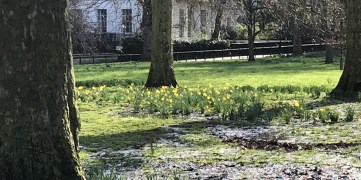
0217 daffsOut at 7 for a pleasant cappuccino-and at Les Filles, then back to the room to kill time. Out at 9am for the Royal Mews, by Tube to Green Park, and then a nice walk under a clear sky past Buckingham Palace. On the way: backlit daffodils. Of course I was too early for the 10am opening time, so had another cappuccino-and.
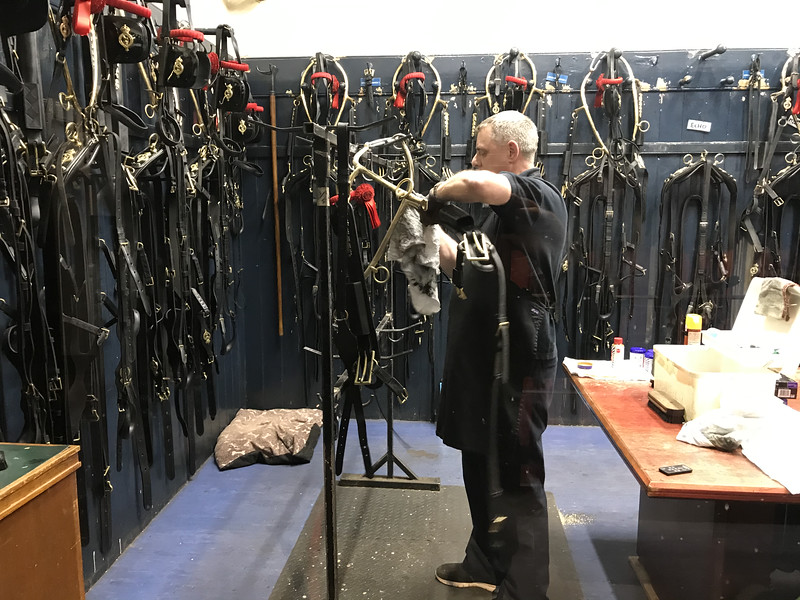
“Mews” is (a) singular and (2) the English word for the building where you parked your horses back of your house, before the French invented “garage”. The Royal one is where they keep all the State Coaches–there are several–and the horses to pull them. First thing we walk by is the tack room, where there was a … tacky person at work?

i-c9ggp4z-l

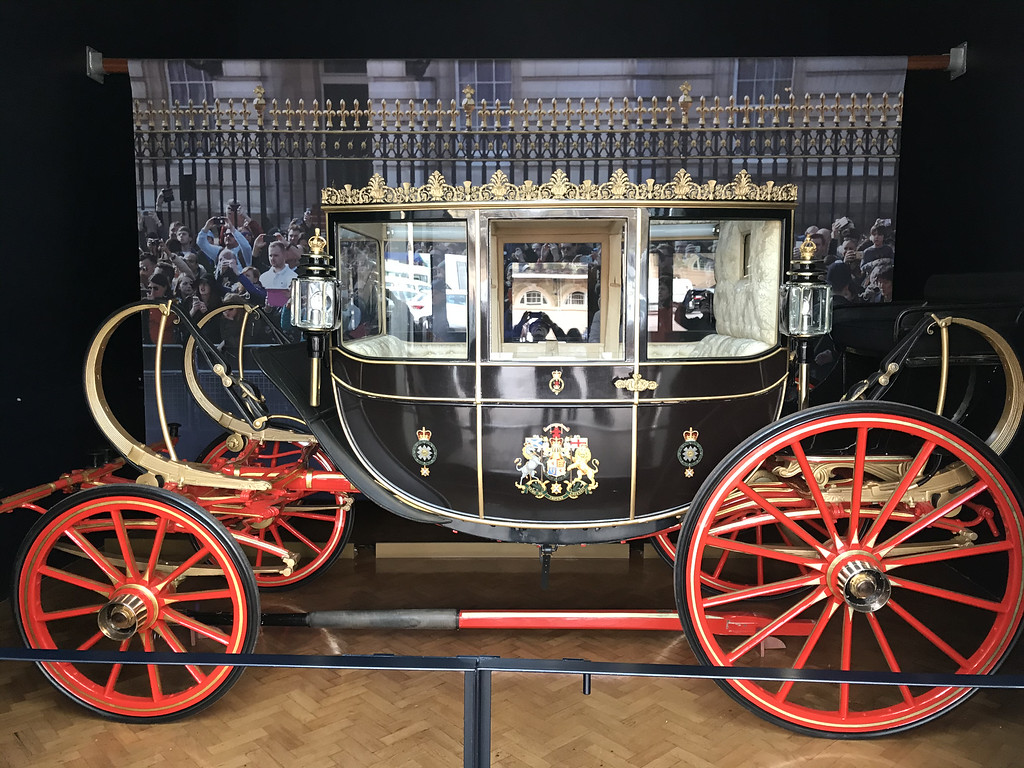
As I said there are several coaches, used on different occasions. They are all here and in tip-top shape I’m happy to say. Here’s one of the lesser ones.

i-ckzpxc7-xl

Of course the prize is the Great Coach of State, a 4-ton monster of neo-classical themes gone wild then gilded.

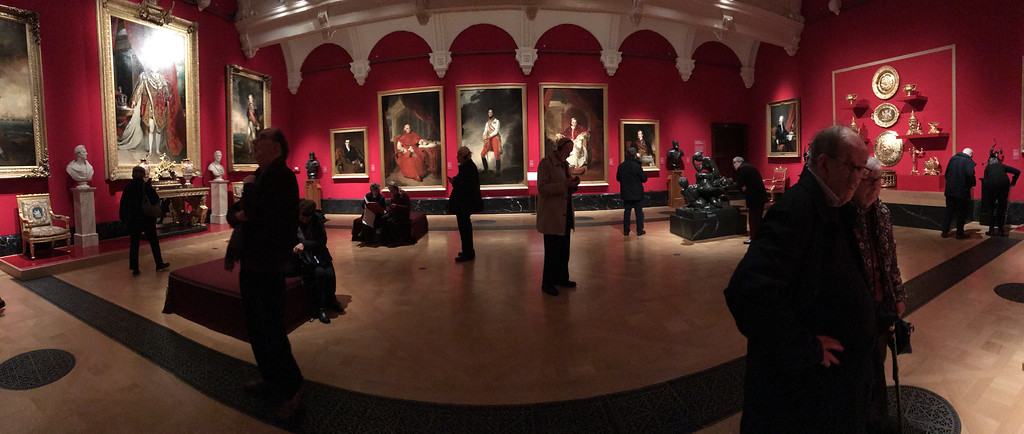
So that was that; now on to the Queen’s Gallery, just next door, where there was a special exhibition based on the collections of George IV, whose whole life was as good as a soap opera— but boy did he have good taste. The exhibit of extremely nice things takes up several rooms. I took pictures of some of my favorites but it’s too much trouble to put them here. Instead, a panorama of one of several rooms.

i-pxtswgg-xl

A point that seemed interesting to me: almost all the people browsing this exhibit were seniors, my age and older. In the Mews and other galleries there’s always a mix of ages. Not here. It was quite noticeable.

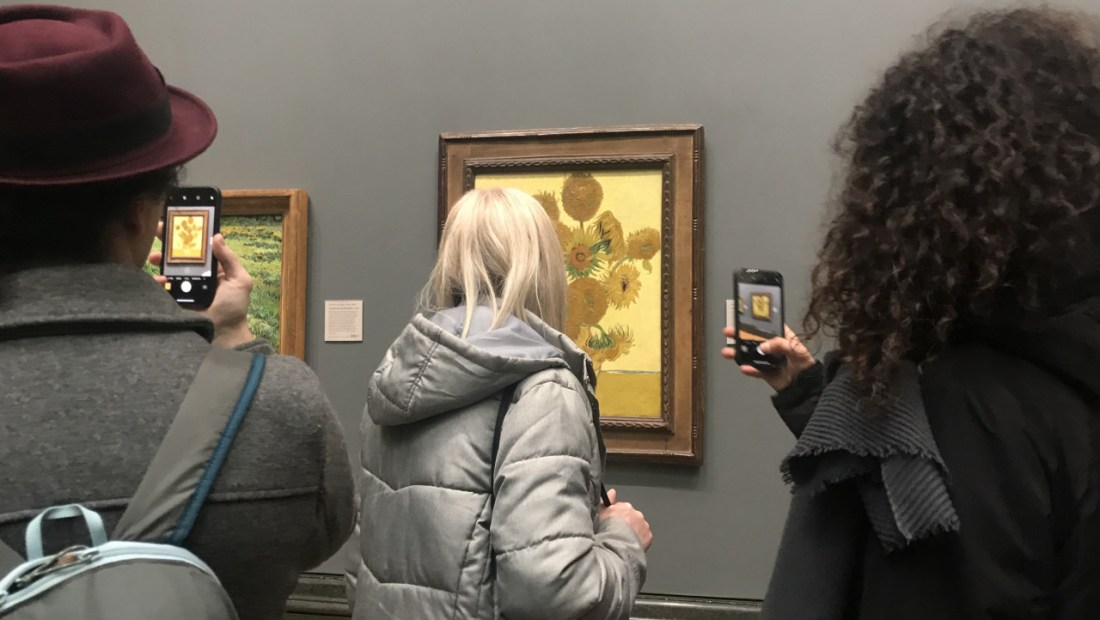
Now it was nearing noon. I called for an Uber to take me to Trafalgar Square where I mounted a second assault on the National Gallery. I’d left off in the 16th Century; now I made it the rest of the way through the 18th, 19th, and… I don’t think there was a 20th Century gallery. There were more people than my prior trip, suggesting what a scrum it might be in summer, but still not unpleasant. Except one small stretch of wall where it was hard to move. Can you guess where the crowd was thickest?

0217 gaugin

I finally ticked off the last room on the map in the brochure, and went down to the basement to the National Cafeteria (really) where I had a tuna sandwich and a dessert. And up to street level and next door for the National Portrait Gallery.

This institution has only portraits, either by famous British artists, or of famous British subjects. Here I was both disappointed and relieved to learn that the whole of floor 2 was closed off for renovation. That’s all the portraits from before about 1800. I walked fairly fast around the remaining floors. I was looking for famous people, or people of whom I had some association. I spent longer in the one room set aside for Technology and Science, admiring portraits of Huxley and Darwin and Lister and Stephenson and Brunel.  Well, I knew what those guys had done, and admired it. As opposed to any number of famous politicians and military offices. Down a floor to the 20th C., where they have moved on to photography for contemporary people. And pretty much… done.

Back to the hotel to blog and rest up for the evening’s outing.


1.076 docklands, Cutty Sark, Greenwich

Sunday, 2/16/2020

I slept in unusually late for me, 8am, which made me a bit late. I had booked an entry to the Cutty Sark for 10am; travel time would be roughly an hour; I needed to shower and shave; where would breakfast fit in? In fact there was really no rush and I knew it. That 10am entry time might matter in the summer, but I expected (and it proved correct) that there would be no line of people and I’d have this major attraction largely to myself whenever I showed up.

Still, out the door at 8:30, toddle up the block to Les Filles, and oh dear, the girls are swamped, place is jammed. Oh well; plan B, go to Greenwich and find breakfast there.

The route was Central Line to Bank, change for the DLR (later I learned it’s Docklands Light Rail), an above-ground line. That ride, even on a dark and rainy morning, was an eye-opener. I’d never gotten to this end of London, the Docklands so called. This is where the greatest part of development has been happening since… the 80s? 90s? Anyway, the train rode a curving viaduct for a couple of miles through an amazing forest of tall buildings. Huge buildings with styles of every recent decade, rectangular apartment blocks, cylindrical glass things, octagons, on and on. And large construction sites where they are building more.

Finally the train crosses to the South bank of the Thames and I got off at Cutty Sark station. A few steps out the station door, and there’s the famous ship just a hundred yards away on the left. (A picture I didn’t take, alas.) But it was not yet 10, and looking to the right I could see that Greenwich has a friendly looking village high street look, with small shops and restaurants. Walking that way I found a nice restaurant for breakfast; a chain outlet, Bill’s; no idea if it is related to the Bill’s that opened a couple years ago on Middlefield in Palo Alto.

Fed and caffeinated, I put up the umbrella and walked back to the Cutty Sark. The preserved tea clipper is in a permanent dry-dock with a remarkable glass roof.

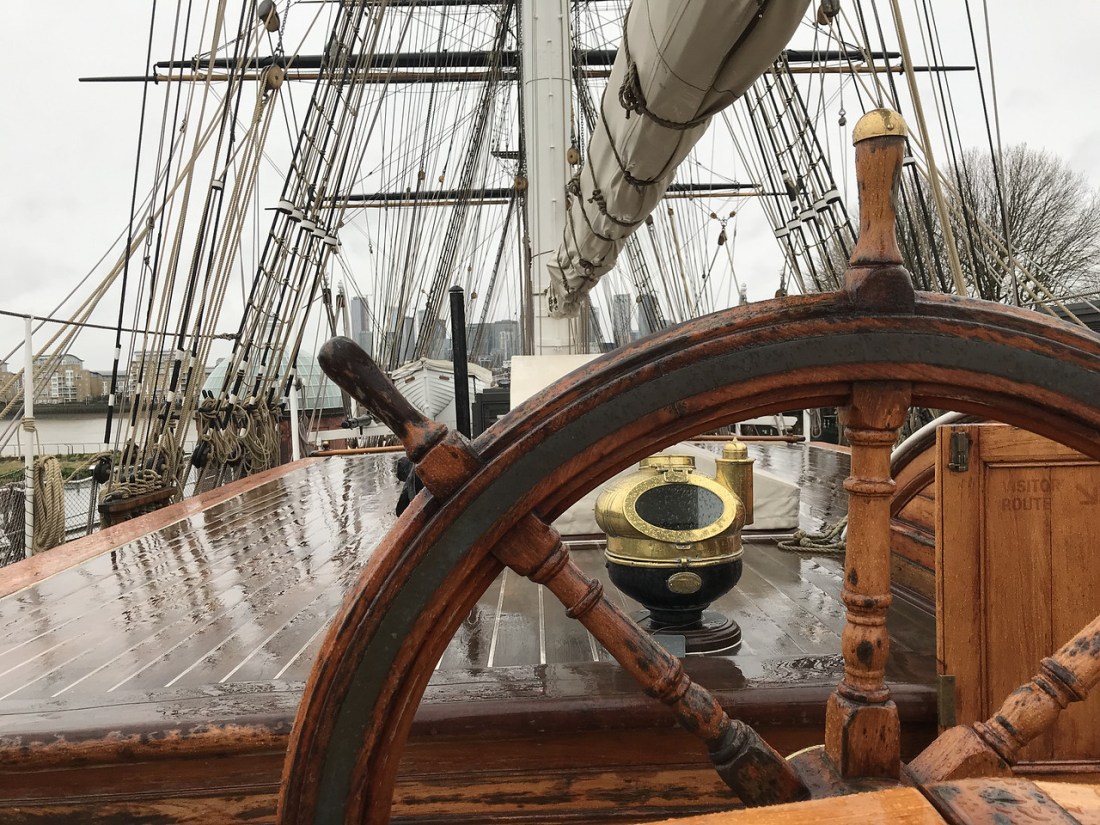
The site does a nice job of teaching you about the construction of the ship and its long use hauling tea from China, and later wool from Australia. You walk through the hold and up to the deck where you can step into the restored foc’s’l and see the sailors’ bunks, and peek into the galley and other rooms, then back to the officers’ quarters. I took a few snaps which I’ll try to organize later. Here’s the helmsman’s view, steering straight into the Docklands.

i-nhzzvv3-x2

i-lbg36nl-xl

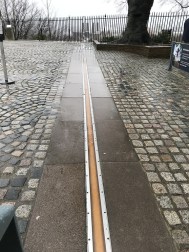
Next thing was to visit the Royal Observatory. This is a half-mile walk away, through the town center, across a park, and up a rather steep hill. Once at the top and into the site you can stand on The Meridian. From there is a rather nice view of the Docklands. Inside the buildings are very nice and informative displays on the work of the Royal Astronomer, and on the famous Longitude Problem and the intricate clocks that were made attempting to solve it.

So that was that and I headed back down to Greenwich town and the DLR. On the return trip I thought I’d switch up the route. Coming down I’d taken the Central Line to Bank for the DLR. Now I’d take the DLR only to Canary Wharf (a vast office/residential/shopping complex) and change there to the Jubilee Line. That worked, but I was surprised to find that to get from the DLR’s above ground platform to the deep underground Tube, I had to traverse two levels of a huge, and very posh, shopping mall. Anyway, eventually back to my modest hotel. Nothing booked for tonight! What ever shall I do?

…well, as it happened, nothing. I went out for supper at a neighborhood Italian place, very acceptable Tortellini, and then watched TV in my room.

However, I also booked myself for two performance events, Monday and Tuesday night.


1.075.2 Vivaldi

After blogging and a nap I headed in light rain to attend a concert at St. Martin’s-in-the-fields, an old church that fronts on Trafalgar Square, at the National Gallery’s left elbow as it were. Looking at their website I see they have the Cafe in the Crypt. So fine, I’ll eat dinner there.

By now, Saturday 6pm, the Central Line trains were as jammed as they would be at rush hour on a weekday, to my surprise. Indeed at Bond Street station, where I wanted to transfer to the Bakerloo Line, the crush on the platform was so scary-dense that I couldn’t get to the exit to Bakerloo, and had to take the “Way Out” doorway that led only to the street. So, tag out with my Oyster card, turn around, tag back in, down a different escalator to the other line.  And on three stops to Charing Cross.

There’s a weird thing going on: I completely miss large obvious things. When I was around Trafalgar Square the other day, I walked up from the Horse Guards Parade and around to the National Gallery, and I never noticed the Charing Cross underground signs. When I came out of the National Gallery, I wanted an underground and couldn’t find one, ultimately taking an Uber.

Tonight, I came up out of the Charing Cross underground, one block from St. Martin’s-i-t-f, and from the street it couldn’t be more obvious. Where was it two days ago? Oh well. Unreliable narrator here, don’t trust anything I say.

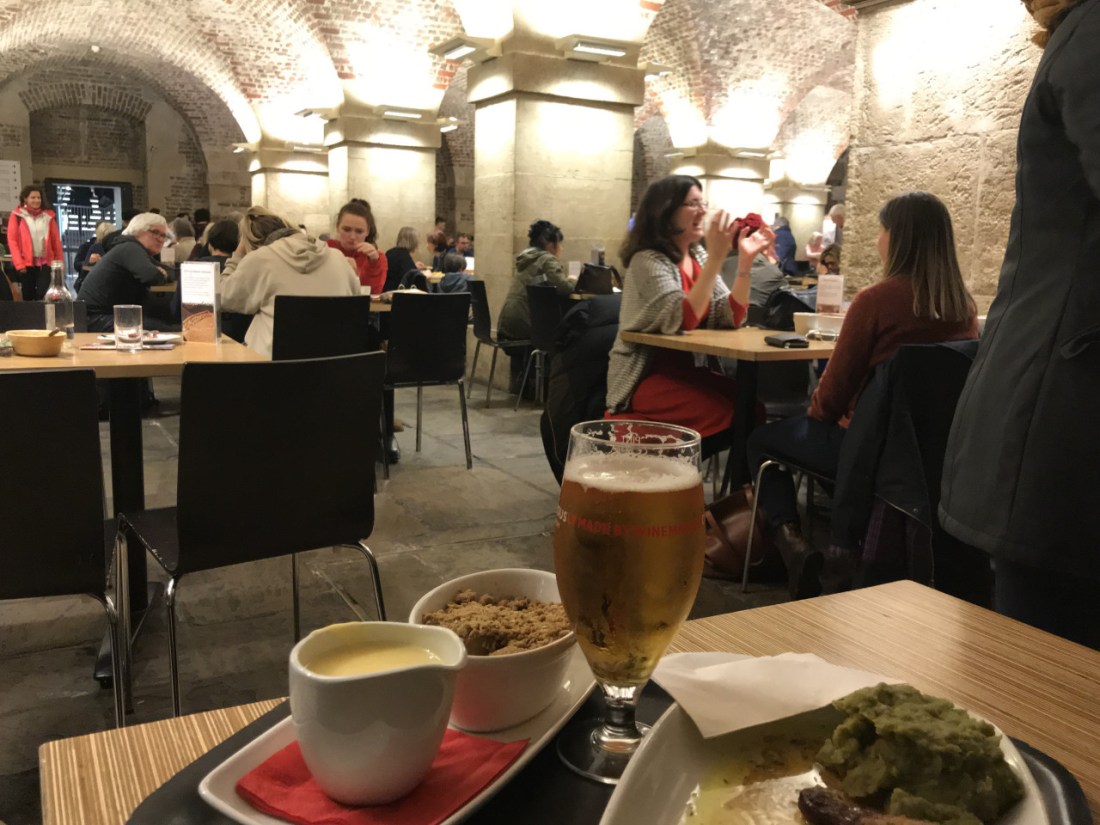
The Cafe in the Crypt is actually a cafeteria. You take a tray, get some food, pick up utensils, and find a seat at one of many tables. This picture shows several things besides the general layout.

0215 cafe

One, my dinner featured mushy peas, something I’ve only had in England and in Sydney, Australia. They’re good! Two, the desert is apple crumble, but served with a big pitcher of white sauce. That took me back. This slightly-sweet milk sauce is a standard condiment with British desserts. The IBM cafeteria where we worked in the 70s always had a big pitcher of it for you to pour over your dessert.

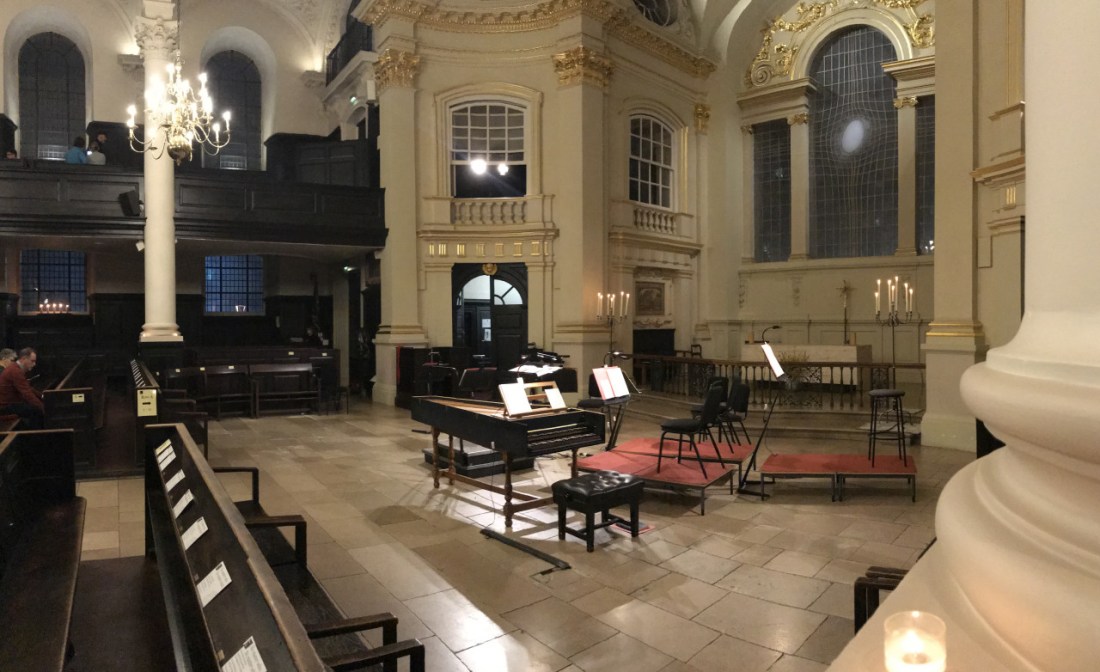
OK, dinner over, up the stairs to the Nave for the concert. Thanks, I guess, to my booking early–this was the first booking I made, early November–my seat was in the front row.

0215 altar

The musicians were the London Musical Arts Orchestra, artistic Director and conductor, John Landor. It was a sizable ensemble, harpsichord, two celli, a bass, a violist, at least six violins.

The first half of the program started with a viola concerto by Telemann, 4 movements. Doofus that I am, I neglected to get a program sheet on the way in (I don’t think I was offered one, but see above about not noticing things). So the next thing sounded real familiar and I was wondering what it was. (Pachelbel’s Canon in D) Also the next one (Bach’s Air “on the G string”). And the first half finished with Mozart’s Serenade in G (a.k.a. “Eine kliene nachtmusik”). Well, at least I knew they were familiar, even if I didn’t name them. The second half was Vivaldi’s Four Seasons. By now I had a program, so could follow along with the different movements.

I assume the musicianship was top-notch. The experience was classical, except for the wooden pew which was medieval.

1.075.1 Bletchley Park, NMOC, Codebreakers, Euston panic

Saturday, 2/15/2020

I should mention that my run of surprisingly good weather continues. Yesterday rain was forecast for the afternoon, so I carried my umbrella, but never opened it. Today the forecast is for cloudy only, so I went out without the umbrella. Of course, I got rained on, but only a little.

My breakfast spot, Les Filles, didn’t open until 8, so I had breakfast in the hotel. Then off to Euston station via the Central and Northern lines. I’d not been in a British rail station in modern times. There’s a vast open hall with a gigantic reader board spelling out in detail which trains are departing when and from which platform, and exactly what stops they make. I took the 9:15 to Crewe whose 2nd stop was Bletchley. And off we go, as smooth and fast as the German trains I enjoyed a decade ago. The first half hour is through pretty dreary industrial suburbs. About the time open fields and trees appear, we are stopping at Bletchley.

Out of the station, it is not entirely clear where to go; there’s no signage to Bletchley Park or its two museums. But the maps app suggests turning right; and there just down the road is a modest sign for the Park. Inside, the pedestrian visitor hoofs it quite a ways before a small sign directs him to the visitor center for the Codebreakers museum. Persevering through the car park one finds another small sign that points up hill to the building that houses the National Museum of Computing (NMOC). I was a few minutes ahead of opening time but fortunately the door was open so I could shelter from the light rain while the staff got themselves together.

I shan’t write much about the NMOC at this point. I was very interested, saw several neat things, and took pictures and videos. But I want to put those all together in some coherent sequence, either as a separate blog post, or as a slide show, so that I can talk to my fellow CHM people about the NMOC and my impressions of what it does well and poorly compared to us.

I had a fairly pathetic sandwich in the NMOC’s shop/snack bar, then went down to the Codebreakers exhibit. This separate museum tells the story of all the people who worked on the process of gathering intelligence from German radio transmissions.

There were many parts to the process. There were separate listening stations with directional antennas up and down the British Isles and they tried to triangulate so as to know the exact source of a transmission: was it in the North Atlantic? Was it moving? and so on.

The transmissions were recorded; they were frequency-shift keyed audio, bleepity bleep. This was rendered visually by a pen on a strip of paper showing the high and low tones. It was explained to me that it was a five-bit code, plus a low start bit and a high stop bit, so seven bits to a character. The wiggly line on tape was transcribed by eye to characters. That is, operators read the wiggles on tape, mentally picked out the character patterns, and hit keystrokes to transcribe them as holes in punched paper tape. Of course the transcribed characters were a random sequence; the messages were enigma-encoded strings. For that reason, each transmission was transcribed twice, then the punched tapes were visually compared to find mismatches, which would be transcription errors that would mess up the decryption process.

The transcribed punched tapes were given to motorcycle couriers (who were often women, WRENs) to drive to Bletchley. There the decoding process began. At first decryption was manual. Later it was done using the “Bomb”, an electro-mechanical device, and later still the Colossus, the kinda-sorta digital computer based on Alan Turing’s work, but actually implemented by engineers from British Telecom.

After decoding, the transmissions had to be translated by people who understood German military vocabulary and special terms, and then interpreted by intelligence people and delivered to decision-makers.

The Codebreakers is a pretty thin exhibit; it has display cases with artifacts of the workers, including their working papers and books; and interpretive panels. However other than a courier’s BSA motorcycle, it has no hardware to show. All the decoding stuff, the Bomb and the Colossus, are up the road at the NMOC. I was in and out in a half-hour, and I wouldn’t recommend it to anyone else.

So, back to the Bletchely station and was happy to learn a Euston-bound train was due in 15 minutes. The train up had been nearly empty, but southbound in the afternoon it was nearly full.

At Euston rail station I was out the door, around the corner, and into Euston underground station, and as I neared the top of the down escalator a very strange scene was taking place. There were two escalators going down, as usual with a solid line of down-going people on each, but as I walked up to the head, there was shouting, some kind of disturbance ahead, and… there were people climbing up the down escalator, pushing past the people standing going down. Lots of people were coming up, which is quite an effort; those escalators are not slow.

My first thought was, it’s a few kids having a bet. But no, they were mature people and they weren’t laughing. Slowly it dawns on me and the other people who are backing up into a mob at the head of the escalator, that they are running away from something down below on the platforms.

London Transit people responded with admirable promptness. Both escalators were stopped immediately. Transit people in orange vests started saying, back up please, we have a situation, leave the station. I heard someone near me say, “there’s a suitcase”, which I took to mean, an abandoned one that looked suspicious. I have no idea if that was the case. Realizing I had nothing to contribute or to learn, I turned around and exited the station.

(Four hours later the Manchester Guardian reported: British Transport Police said “Officers were called to Euston station at 1:27pm following reports of an altercation between two men involving the use of a knife. Our investigation found that there was no knife involved and no stabbing took place. The incident has been classed as ABH assault.” It must have been a pretty violent altercation to cause at least a dozen people to climb up the down escalator to escape it. But whatever; life in the big city.)

Out on the street, in light rain; how to get home? Euston is a bus transit center, and I asked at the bus kiosk if there was a bus that would take me near Lancaster Gate. No, I’d have to use two buses. Pfft, I’m too good for that, I’ll take a cab or an Uber. However, there are police sirens in all directions (and I have to say, modern emergency vehicles have ordinary sirens, no more klaxon hee-haw noises) and pretty clearly traffic will be jammed around here, and cabs hard to find. So I walked a few streets away. No cabs in sight so I called an Uber, which took a while to come, but was driven by a jolly Jamaican man, and the ride took me through parts of London I hadn’t seen. Regent’s Canal, with narrow boats parked along it, for one.


1.074, Shopping, British Museum, dance

Friday, 2/14/2020

Yesterday afternoon I looked ahead at planning a trip to Bletchley. It involves a short train ride out of Euston Station, but I found I couldn’t book tickets for less than 24 hours ahead. Which meant I couldn’t book for today, so I booked instead for Saturday. By the way, the Midlands Rail website worked well; it sent me my ticket via email but in a form that I could load directly into my Apple Wallet. So that was all set for Saturday, but what would I do Friday?

I got out my list of museums that I’d made up in November and was about to opt for either finishing the National Gallery, or the Science Museum, when I realized OMG the British Museum itself! OK then. On its website I found there was an 11:30 tour, “Around the World in 90 minutes, highlights of the museum”, for a fee (as contrasted to the usual docent tour which is free). Book it!

I left at 9:30, the now-familiar four-stop run from Lancaster Gate to Tottenham Court Road that I’d used for &Juliet and Faulty Towers. The street leading to the museum’s gate is lined with tourist shops (the museum must draw visitors by the million in summer) and among them I noticed one that featured Scottish woolens and cashmere. Hmmm. On impulse I stopped in and the lady was happy to show me a light cashmere sweater, quarter-zip, shawl collar, coffee-brown, exactly what I wanted! So I bought it. Probably paid too much, only a bit less than Harrod’s wanted (but theirs wasn’t cashmere). Anyway, that’s done.

Into the museum. The fore-court is lined with serpentine crowd control barriers. Again, as if they were ready to handle huge numbers of people, although today there were only dozens. Into the museum, pay £2 for a map, and start wandering. Yesterday I wrote of the V&A, so much stuff. Hah. I didn’t know what so much meant. This one has everything the inquisitive, acquisitive, sticky-fingered brits collected as they spread out over the world in the 18th and 19th centuries. Just casually, here’s a hall of Egyptian mummies, there’s the hall of Elgin marbles that I saw reproductions of in Athens last year, and over there, yeah, that’s the Rosetta stone. Whatever, no big thing.

The building rambles out from a central court in concentric square rings of halls. I got all the way around one ring before it was time to go to the meeting point for the tour. The tour was led by Peter, a friendly Yorkshireman, “you may have noticed I’ve retained just a trace of an accent?” No problem, Peter, I’ve watched I don’t know how many Britcoms set in Yorkshire.  We were a group of 8 (“I usually have about 20, this is the perfect number”). Peter led us wide around the museum stopping at a dozen objects “selected by the curators of each gallery as a highlight.” The Mildenhall chess set, the Sutton Hoo helmet, Lindow man (a body preserved in a bog for 2000 years), the Oxus treasure, a lion from Nebuchadnezzar’s gate, on loan from the Pergamon museum in Berlin (been there), the David vases (earliest known blue and white Chinese porcelain), an Easter Island statue, a study reproduction of the Rosetta stone (“you can touch this one, we’ll walk by the real one shortly”) and the Parthenon marbles. Couple others I didn’t note.

It was a fun and entertaining 90 minutes. Peter did a good job, clear, informative, and funny. British docents are so far scoring very high with me.

But I’d now been museum-gawking for three hours and my feet hurt, so I left, stopped by the woolen store to pick up my sweater, and back to TCR underground. Now to plan the route to the Barbican for tonight.

When I was booking things last fall, I wanted to have some kind of dance performance, and found this one: “Anton and Erin dance the great movies”. I didn’t bother researching who Anton and Erin were. Well it developed over the course of the evening that Anton du Beke and Erin Boag were long-time professional dancers on Strictly Come Dancing, the British reality dance show that was copied in the USA as Dancing with the Stars. This was a tour they’d organized, and most of the people in the audience were fans of the TV show and had been watching them dance for a decade.

Besides Anton and Erin there were three male and three female dancers, two singers, and an orchestra of at least 30 pieces. There were a number of dance routines, a lot of costume changes, lots of floofy gowns and tight revealing outfits, and it was fairly entertaining. In the first and second halves combined, Erin and Anton spent at least 20 minutes, I kid you not, in chit-chatting with the audience, answering questions, reminiscing. That was pretty feeble stuff for me, since I didn’t have the associations. In the audience, introduced from the stage, was Len Goodman, a familiar name to me as he has been a long-time judge on Dancing with the Stars.

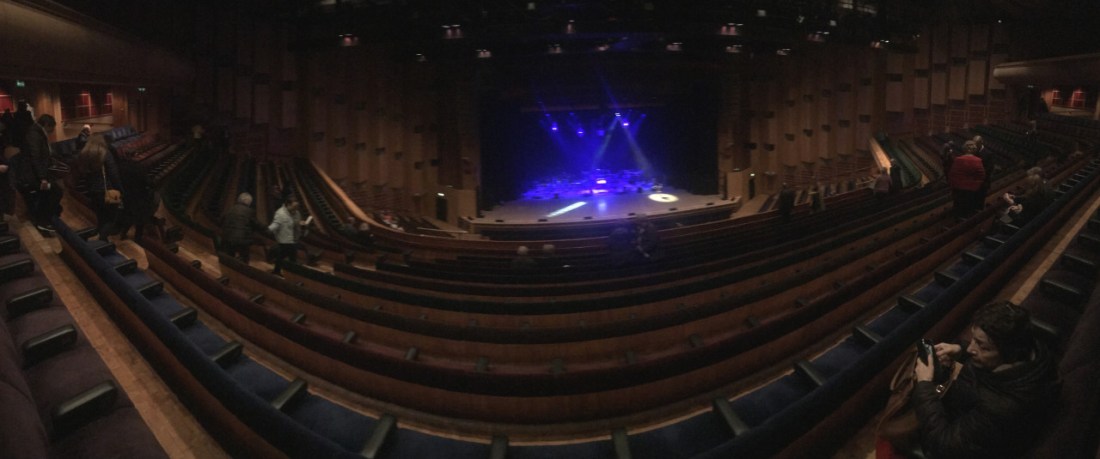
Part of the attraction of this booking was that it was held at the Barbican Centre, which I’d never been to. I almost wasn’t to it this time. It’s only 3 blocks from the underground station, but there were no signs, and Apple Maps went completely spastic on giving directions, sending me first one way, then another. Possibly confused by being in a forest of very tall buildings and overpasses, but I must have walked 20 blocks to cover that three, and ended up coming into the venue by a back door. When you finally get in, it is a very large hall. Quite handsome. This panorama doesn’t do it justice.

0214 barbican

The seats were wide and very comfortable. I had booked a front-row balcony seat and had good sight-lines.

1.073.2 Faulty Towers

Note spelling: I think they are treading carefully around Intellectual Property issues. Anyway, the Faulty[sic] Towers Dinner Experience is literally, dinner theater. You gather with about 40 of your new friends in the lobby of a Radisson Blu hotel and be sippin’ drinks when an awkward Spanish guy in a waiter’s jacket comes in and starts making mistakes serving snacks, and Basil Faulty comes in and slaps him around and then Basil’s wife Sybil comes in and takes Basil to task for losing the seat assignment chart she just gave him, but it turns out it’s in his pocket after all, and he proceeds to call out names and with many sarcastic comments directs us to our tables in the dining room next door.

And it goes on from there, an actual three-course meal gets served over the next 90 minutes, but there are continuing mishaps and disasters between the three characters, many of which are familiar if you can remember the original TV series. Like Manuel having a pet rat, which he insists “No, is HAAAMSTER, meester Faulty”. And of course the rat gets loose and Basil and Manual are chasing it under the tables.

I was seated between Rebecca, a young-ish woman who was there with her partner and her father; the father, about my age, was visiting to do some handyman work around the flat, and they wanted to give the old man a treat. On my right was… I forget her name, very outgoing woman, we talked about the California vacation she’s planning with her husband who was across the table.

It was all pretty amusing and fun. The three actors were physically very close to the originals, had the voices and accents down pat, good comic timing, and all told did a great job.

Oh, and the papers had dire forecasts for heavy rain, which did not develop. I’ve been carrying my umbrella but didn’t have to open it at all yesterday. The weather has been remarkably mild.