
Thursday 08/10/2023
Did the gym machine round, tidied the apartment for Wanda’s 2pm cleaning, then headed to Milpitas to work at the Shustek center. In the morning shift, I worked with Dave B. to catalog items from a donation by Len Shustek himself. Shustek has made several appearances in my life lately. Two weeks ago I spent several sessions watching a 12-hour course he recently taught at Stanford on the history of computing. Over the VCF weekend he was hanging around CHM, I saw him go by several times. Now I’m cataloging stuff he has donated from his personal collection.
Shustek got a physics doctorate from Stanford, then worked for a while at the Stanford Linear Accelerator Center, the electron-smashing place in the hills west of Stanford. Then he founded not one but two successful Silicon Valley companies, Nestar and Network General. He did that along with another Stanford physicist, Harry Saal, who for several years was a star researcher at IBM San Jose. I believe I met him one time back in the 70s. Shustek married Donna Dubinsky who herself was founder of Palm (remember the Palm Pilot, the first real PDA?) and another company.
So what he had donated that we cataloged today was a “Sniffer”, which was a portable Compaq PC set up to do network traffic analysis. It was Network General’s first big product. But the other was the real prize, as far as I and Dave B. were concerned. It was an Altair 8800, the first real home computer. Just an Altair would not be such a big deal, we already have several, and in my docent tour I always stop at the one on display and talk about it. But this one was different. It had a SLAC property sticker, and it had been heavily modified, and was just stuffed full of boards, many of them hand wire-wrapped.
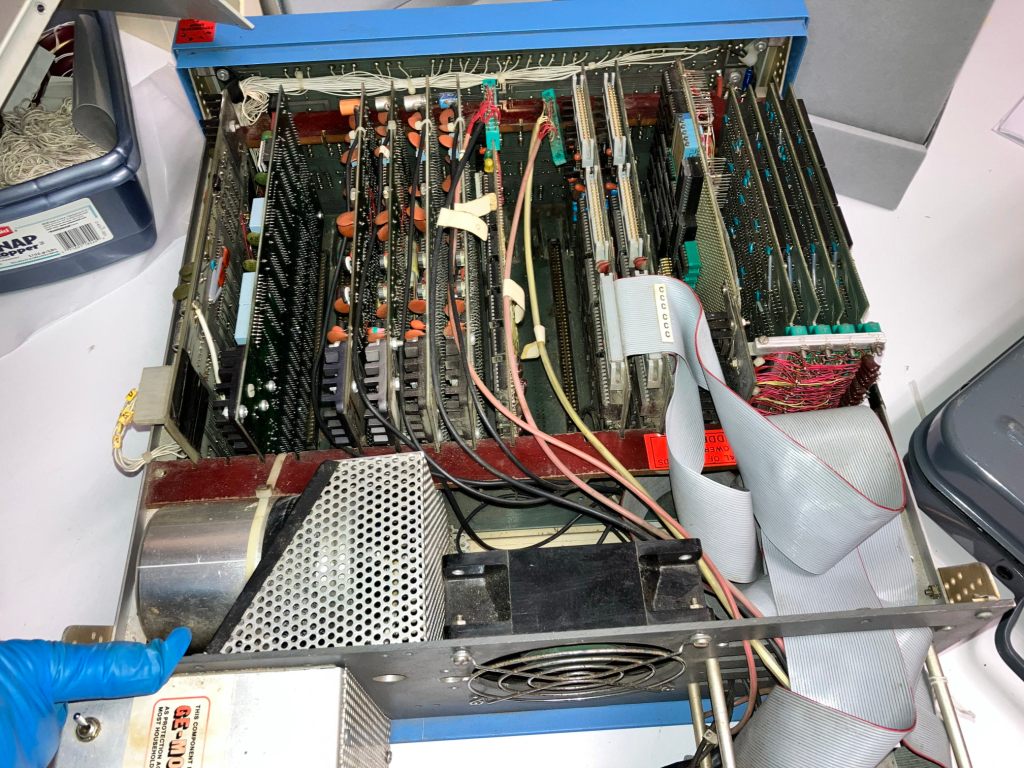
We got out the donor letter and found out that this had been ordered in 1975, so it was an early one. It was used in the experimental physics lab at SLAC, for various kinds of experimental measurements. That makes it very much one of a kind.
After lunch I worked on de-duping documents. We have piles of documents, mostly manuals from early computer companies, in a big donation. Some of them exist in the collection already. The game is to pick up a document, and try using various searches to find the same document in the collection. The records aren’t perfect, so sometimes to be certain you have to down the long aisles in the document storage area and pull out a box and look in it to find the match, or not. Non-dups go in a pile to be cataloged. Dups go in the recycle box.
 Codgerville